Interviews
Interviews
Rob Kaman
From 'Talking With A Living Legend' - 1995
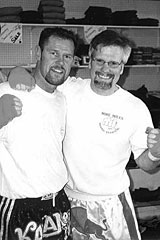
I was very excited about this interview. I have long admired Kaman for his fighting ability. In the early 1980s, with Urquidez and Wallace being the big names, I heard so much about Kaman that I was perplexed why no other fighters in North America took him seriously. He soon proved me right and was far too strong for any North American fighters. However, due to a personal problem he had to take a short hiatus from the sport, and I believe this resulted in hurting his chance for early notoriety in North America. After he straightened out his problem he went on to conquer the Kickboxing world and defeat the toughest competition in Thailand and Europe. Respected and well known throughout Europe, the Orient and finally now being paid his due in North America, he is now referred to as a 'Living Legend'. Many of my peers and instructors have criticized him for not being a thinking fighter. I have long disagreed, and found Kaman to be an intelligent fighter who is almost always one step ahead of his competition. For a while my teacher in Thailand had wanted me to fight 'The Dutchman', but I never really was interested. Kaman is in a league of his own. Finally, the proper pronunciation of his name is 'Kah-mahn', not 'Kay-man' like so many Americans call him.
MM: When did you first start training in the Martial Arts?
RK: It was in 1976 at the age of 16.
MM: How old are you now?
RK: I am 35 years old.
MM: Did you do any other styles before you started fighting in MuayThai?
RK: I started with Pentjak Silat and studied this art until 1978.
MM: Who or what inspired you, Kickboxing or MuayThai?
RK: It was a complete and total art or sport. It requires proficiency in the technical, physical and conditioning aspects. I was then witness to one of the very first Kickboxing cards in Holland. I was impressed by Dutch fighter Lucien Carbin who fought on this card. We made fast friends and he took me to the Mejiro Gym where I started training under Jan Plas.
MM: When did you have your first fight, against who, under what rules, and what was the outcome?
RK: In September 1978 I fought Carilon who was the Boxe Francaise Savate Champion. The bout was in Paris, France and I lost on points. Looking back at it I am glad I lost this fight because it brought me down to earth and taught me it takes a lot more hard work and training to become a true champion.
MM: Have you ever fought in North America?
RK: Just once, when I beat Moncayo in our rematch encounter in Florida. I have trained over there with Blinky Rodrigues and Benny Urquidez.
MM: What is your present fight record?
RK: I have 98 Wins, 9 Losses and 0 Draws, with 78 KOs.
MM: What are the titles you have won?
RK: I have won titles for all the major sanctioning bodies including the WKA, ISKA, IKBF, and IMF Thai Boxing.
MM: Which of your fights do you feel are the most noteworthy?
RK: There are so many that I do not find it easy to pick one or even several of them.
MM: Who was the toughest opponent you have ever met in the ring?
RK: I think my fights against Thai fighter Cheungpuek Kiatsongrit were the toughest. He has a very hard left round kick. The first time we fought I lost on points. the second time we fought I won by knocking him out in the fifth round. The third time we fought I lost on points in Bangkok. The fourth time was at the Japanese K-2 where I let him beat me.
MM: Let him beat you? You and Hoost were favored to win that tournament. Hoost did.
RK: This was at the Japanese K-2 Grand Prix. My first draw was against Cheungpuek. I sustained a nasty cut in my leg early in this bout. I knew that even if I won this bout, my next opponent would be Tasis Petridis, who could also hurt me. Even if I had reached the finals, I knew I would not be in condition to win against Hoost. Therefore after the cut, I let Cheungpuek win.
MM: Who are your fight losses to?
RK: Carilon, Muniz, Krongsak, Cheungpuek, Lakchart, Peter Smit and Rick Roufus.
MM: Would you like to rematch any of these guys and if so, in the near future?
RK: I would love to rematch Rick Roufus, but under my rules allowing leg kicks. I have been handicapped fighting him under his rules, so he should try my rules!
MM: I remember your first bout with Roufus. This was when Theriault pulled out of your scheduled encounter.
RK: : I was supposed to fight Jean Yves Theriault in Paris. About two weeks before the bout, the promoter called me and told me that Theriault had pulled out due to a broken hand. I was very disappointed. I stopped training because I felt I would be fighting just another wimpy American Full Contact fighter. I even taught a seminar in Italy days before the bout took place. Roufus turned out to be no wimp and we had a twelve round war. I would like to say that in the fourth round I was on the verge of knocking him out when the bell rang at 1:15 into the round. All the other rounds were two minutes, except the fourth. Isn't that a little strange?
MM: No kidding? In your second encounter he knocked you out though.
RK: This was due to my own stupidity. Normally my game plan is to irritate, let my opponent come, and look for openings in his defense. In the second encounter I was too keen and got careless. I took the fight to him and suffered the consequences.
MM: What about Rick Roufus and the rematch with leg kicks rumor? People in his camp state the rematch between you and him allowing leg kicks has never been agreed upon and never will be. Any response to this?
RK: All I can say is that Rick Roufus is not an all-round Champion fighter. He can only fight under one set of rules, which is Full Contact, whereas I can fight all styles and I am an all-round Champion.
MM: You are the first fighter in history to sit on a legitimate MuayThai, Full Contact and Kickboxing World Champion Title at the same time. How do you feel about this?
RK: Great! I think many champions hide behind their organizations for protection. I wanted to prove I was an all around fighter and could fight under all the rules.
MM: Lately, you have received much criticism by people stating you are old or washed up. Yet you won the French K-2. Is there any validity in the criticism of you? Do you feel you are slipping?
RK: Tell me who is not slipping competitively at the age of 35? I still manage to stay at a highly respected and competitive level. To respond to the criticism, I am not washed up! 98 Wins to 9 Losses, everybody loses once in a while.
MM: You have lived and trained in Thailand. Which camps have you trained at while in Thailand?
RK: I trained in Pattaya City at the Sidyodtong-Payakarun Camp. I do not like Bangkok, but Pattaya is close to the ocean, so I like staying there. I also get along great with Acharn Yodtong.
MM: You made this camp very famous for foreign fighters to visit. It is now regularly visited by Europeans and a few North American fighters. Out of curiosity, why have you only trained at this camp?
RK: Like I said the camp is far away from the hustle and bustle of Bangkok. It was very near to where I was staying when I first came to Thailand. The other reason for staying there is that I do not like change in my program. It has become a place where I am very familiar with the people and the surroundings.
MM: How many times have you fought in Thailand?
RK: I have fought in Thailand only four times. This is due to my weight.
MM: How many Thais have you fought and what were the outcomes?
RK: I have fought eight Thais, but I cannot remember all of their names. I lost to Krongsak once. I beat Sittisak once. I fought Lakchart and won twice and lost once. I defeated Surdow and also Payab. I have already mentioned about Cheungpuek, and I am sorry I can not remember the other names.
MM: What do you think of the criticism that if you do not win by knockout in Thailand you will not win?
RK: This is because they have a different scoring system. Punches do not score. A high priority is given to kicks when judges score. It is very frustrating!
MM: Why are you no longer living and training in Thailand?
RK: I think my stay in Thailand had a negative influence on my career.
MM: How's that?
RK: The training there is very monotonous, constantly hitting Thai Pads. I did not have any professional support, no trainer as I had in Holland. No sparring partners were available to me in my weight class either.
MM: Does this explain that since 1978 you were never counted out, yet in 1989-1990 you were counted out twice?
RK: At that point in my career I had a large amount of fights. One after another without the proper preparation. This factor, combined with the tropical Thai climate does not allow you to recuperate easily. It actually put me in worse condition than when I was in Holland. All of these negative elements came together for the first time when I fought Jan Wessels in 1989. I was also the promoter of that event and I was exhausted even before the fight started. The other bout was against Peter Smit in 1990 in Japan. I should not have gone through with that fight. My mind was with my girlfriend who was about to give birth to our baby. I had to leave her in the hospital for this fight, and I had to take sleeping pills to sleep.
MM: Who in your opinion is the best Thai boxer from Thailand today? Do you have a favorite Thai fighter?
RK: My favorite fighter from earlier in my career was Samart Payakarun. He was the main fighter at the camp in Pattaya when I first started training there. At this moment in time I do not follow the Thai fighters, so I do not have a present favorite.
MM: What do you think of the current 'K' circuit? Any criticisms or suggestions of the event?
RK: They are alright. A lot of this event relies on luck for the competitors. You have to be lucky in your draws to be in the right position to make it to the finals. Sometimes I wonder how fair the draws really are. I do not want to go any further than this.
MM: The newest Martial Arts fad is the current Free Fight Gala. Your former sparring partner Bob Schrijber fought in one. What do you think of these events?
RK: You have free fights and cage fights in North America. Which ones?
MM: The Ultimate Fighting Championship.
RK: Hmmmh. When Bob fought he lost two times by being strangled out. They are now trying to promote these events by video. Very few spectators come and watch these events.
MM: Would you ever fight in one?
RK: They asked me already to fight in one in October 1995. They will have two pools, one for Kickboxing and one for Grappling. The winners in each pool will square off at the end for the money. I declined because of my contract in France. When I end my career and if the purse is good, because now they do not offer enough. There is too big of a risk for injuries that can bother a fighter for the rest of their lives. I do not see it as a sport! It is only attractive for the promoters, and the money if you are a fighter.
MM: Getting back to Kickboxing, what do you think about all the different sanctioning bodies and the multitude of titles each one sanctions? Which bodies do you feel are legitimate and which type of fighting from MuayThai, Kickboxing, Full Contact, and Savate do you think they should sanction, if any?
RK: I think it is all bullshit. I think there should be one sanctioning body for professionals and one title for each different fighting style. Unfortunately, we have not learned by watching professional boxing. It is also going through the same problems with multiple Champions and sanctioning bodies. I cannot foresee a solution in the near future for Kickboxing.
MM: Are there any fighters from North America who you think are good? Are there any fighters over here who you would like to fight?
RK: We do not hear about North American fighters in Europe or in Thailand. The ones I have heard about I have fought, including Theriault, Roufus, Robinson, Moncayo, and MacFadden. I feel North America has much catching up to do. I would have liked to fight Dale Cook and there was talk about it for a while in Japan. However, I do not feel he has really fought any notable fighters other than Cheungpuek Kiatsongrit. Cheungpuek knocked Dale out in the second round.
MM: Let's look at the European fighters. Ernesto Hoost is now winning big tournaments and big fights. He knocked Rick Roufus out. Yet you have defeated Hoost twice and lost to Roufus twice. Has Hoost improved that much, and do you think he would be able to fare any better as a fighter against you now?
RK: When Hoost beat Roufus it was under Full Contact rules. When Hoost fought me it was under international MuayThai rules (not allowing elbows). When Hoost and I tangled, we were at our absolute best physically, mentally and emotionally. The bouts could have went either way, but I won. Hoost has improved but I do not know if he would do any better against me.
MM: Will you two ever fight again?
RK: I did receive an offer to fight Hoost in Japan but it was on three weeks notice so I declined. If I was going to fight him, I would want to be prepared. Now it is a different period in time for both of us and I am older. It is late in my career and I doubt we will ever fight again as I will be ending my career soon.
MM: Are there any other fighters in Holland that you think are very good? France? England? Anywhere else in Europe?
RK: There are so many up and coming fighters, that it is difficult to think of any one person right now.
MM: Any good fighters in Japan or other parts of the Orient besides Thailand that you think are good?
RK: Yes, I do. However there are very few of them compared to Europe.
MM: You never fought Don Wilson. Did you ever want to fight him? I know you did a movie together, but how do you think you would have done against Wilson in a fight?
RK: I never fought Don. I have always wanted to fight him. If we fought my only concern would be under which rules the fight would be. I respect him, because he is a smart fighter and even though he is not a MuayThai stylist he has fought Thais.
MM: There are rumors that he wants to come back as a fighter. Any thoughts on this?
RK: I am puzzled to hear he may be coming back. Don, if you are reading this, why? As I think about it, it would be a great retirement match for both of us.
MM: Have you ever fought using elbows? How do you feel about using elbows when you fight?
RK: All of my fights with the Thais allowed the use of elbows. I like using elbows because it is just like any other technique other than it can leave nasty scars.
MM: Is there anything you would like to see changed?
RK: I would like to see one set of fighting rules for all fighters, either with or without elbows, but one!
MM: Theriault was talking about his retirement fight and having you as a possible opponent again? How do you feel about this?
RK: If Jean Yves will accept my weight, I do not see a problem fighting him again. I have been going up in weight to make money. I am presently at 89 kilos. I think this is about 10 kilos over Theriault's weight now.
MM: When you fought and stopped Theriault on June 20, 1992 - he would not come out for the next round - were you awarded the World Title Belt by the sanctioning body ISKA? I never saw your name in any ratings by this sanctioning body. Did they give you the title or not?
RK: No, they never gave me the official Title. ISKA did not give me an official belt and my title was stripped the same day as the fight because I could not make the weight anymore. ISKA sanctioned the event, agreed to my weight, let me fight, and after I won they said I was too heavy for the division. This was bullshit!
MM: What about Roufus and Hoost? Both those guys were over the weight limit and they still gave the title to Hoost.
RK: Just politics again.
MM: Yet, you fought on an ISKA card later in the year against Marek Piotrovski.
RK: The money was good and Marek had made a name for himself when he defeated Don Wilson. I won Marek's ISKA Kickboxing Title on November 23, 1992 by knocking him out. The ISKA gave me a World Title Belt for this fight much later though. It came so late that I was not sure if they reconsidered their decision and gave it to me for the Theriault fight, or if they gave it to me for the Piotrovski bout!
MM: Unfortunately, there has been a lot of politics in this sport.
RK: It is not fair and it hurts the sport!
MM: You have fought Blinky Rodrigues and stopped him. He was a very respected fighter in North America. He is the only fighter to have ever knocked Theriault out cold - in the first round with a vicious left hook - and also brought Bill 'Superfoot' Wallace on the verge of defeat. You have been criticised by North American Kickboxers for destroying his knee. How do you feel about this?
RK: Blinky is a wonderful person. I do not think he blames me for his knee. I have spoken to him many times after the fight and he has never said a thing to me about it. Incidently, by defeating Blinky in the second round - with leg kicks - I was given my first shot at a WKA World Title against John Moncayo.
MM: He was a tough but awkward fighter. You fought him twice. What were the outcomes?
RK: In the first encounter on September 23, 1983 I won by stopping him out in the third round with leg kicks. Moncayo spoke in interviews that he had lent me the title. In the second encounter I knocked him out with a punch in the third round of the fight, and proved I deserved the title. When I won the first bout, it was the first time in history that a European became a World Champion in the sport of Kickboxing.
MM: What are your favourite fight techniques?
RK: Now I have so many, but earlier in my career it was definitely my leg kicks.
MM: What technique are you known for?
RK: Again, my leg kicks!
MM: If you have one, who's is your favourite fighter or fighters?
RK: I like Samart Payakarun from Thailand, Fujiwara from Japan, and Ramon Dekker from Holland. Samart is the same generation fighter as me. We are good friends. He is a great fighter with unsurpassed timing. He used all his skills well and was also a very good boxer. He was a total fighter. Most of the Thai fighters are real tough and not very smart fighters. They are action reaction fighters meaning they kick and then they counter. Fujiwara has the same skills as Samart. In regards to Ramon I have followed him from the beginning of his career. I think he is finally getting back on track as a fighter. He had too many hard fights in a row, and too many scars on the face from elbows. As a fighter he is no longer the animal he was, and hesitates now when he fights. He also is getting too heavy for his size.
MM: What is your opinion about Full Contact Karate (without kicks to the legs)?
RK: I think it is an incomplete form of fighting. It relies almost solely on good boxing technique.
MM: What is your opinion on Kickboxing (with kicks to the legs)?
RK: This fighting is a step in the right direction, towards MuayThai.
MM: What is your opinion on Modified MuayThai (without elbow attacks and knees to the head)?
RK: This is the real thing when it comes to fighting!
MM: Are you a full time fighter or do you work?
RK: I am a full time fighter.
MM: Do you make good money fighting? What do you think can be done to make Kickboxing a better paying sport?
RK: Not enough when compared to professional boxing. The sport needs more television behind it to give it greater exposure, and it needs one set of rules so the spectators can understand the game. The K tournaments offer good pay, but there is a lot of risk.
MM: What do you want to do after you retire?
RK: I want to stay in the sport, but at this moment in time I do not know what direction I will go for sure. I would like to promote good fighters. I do not have the energy anymore to run a camp.
MM: What have you gained from fighting?
RK: Mentally I have gained a lot. Financially enough to survive and I have also put a little aside.
MM: How much longer do you want to fight?
RK: I have said so many times that 'next year' I will retire, but I never have. Finally I think I have reached that point now.
MM: Who do you desire the most to fight?
RK: No one comes to mind other than Rick Roufus allowing leg kicks in the bout. That one excites me.
MM: I have heard from people involved in his camp that he has retired from the Full Contact scene and wants to pursue Professional Boxing. How do you feel about this?
RK: I do not feel he will be capable of being a top boxer. I think he is too far into his career to make the change of styles. He is in his late twenties, and I think he is too old to become a serious contender in that sport!
MM: Are you happy with everything you have achieved?
RK: Yes. I think if everyone calls me a 'Living Legend', I can be proud of what I have achieved. I have also been called the most well-known Kickboxer in the world.
MM: Anything you would like to add to the article?
RK: I hope that Kickboxing will be better paid in the future for the athletes. Hopefully the sanctioning bodies will get their acts together and allow the sport to gain more coverage in the media like boxing.
MM: When was your last fight, and what was the outcome?
RK: My last fight was on June 24th against Australia's Tasis 'Tosca' Petridis. The bout was a draw. A head butt from Petridis ended the fight early with me needing seven stitches over my left eye. It was a bad cut.
MM: Who is your next fight scheduled against?
RK: I am scheduled for a rematch with Petridis in November of this year.
MM: How many fights do you have booked for 1995?
RK: The bout with Petridis ends my contract with France's Canal+. After that fight I will see what I will do with my career.
MM: Thank you for your time and this interesting discussion. I wish you all the best in the future and I hope to see you soon.
RK: Thanks Mike. Take care.

